LEAST CONCERN TEAM
Sophie Cashen
Griffin Joerger
Emma Paxson
Jack Yu
PROJECT STATEMENT
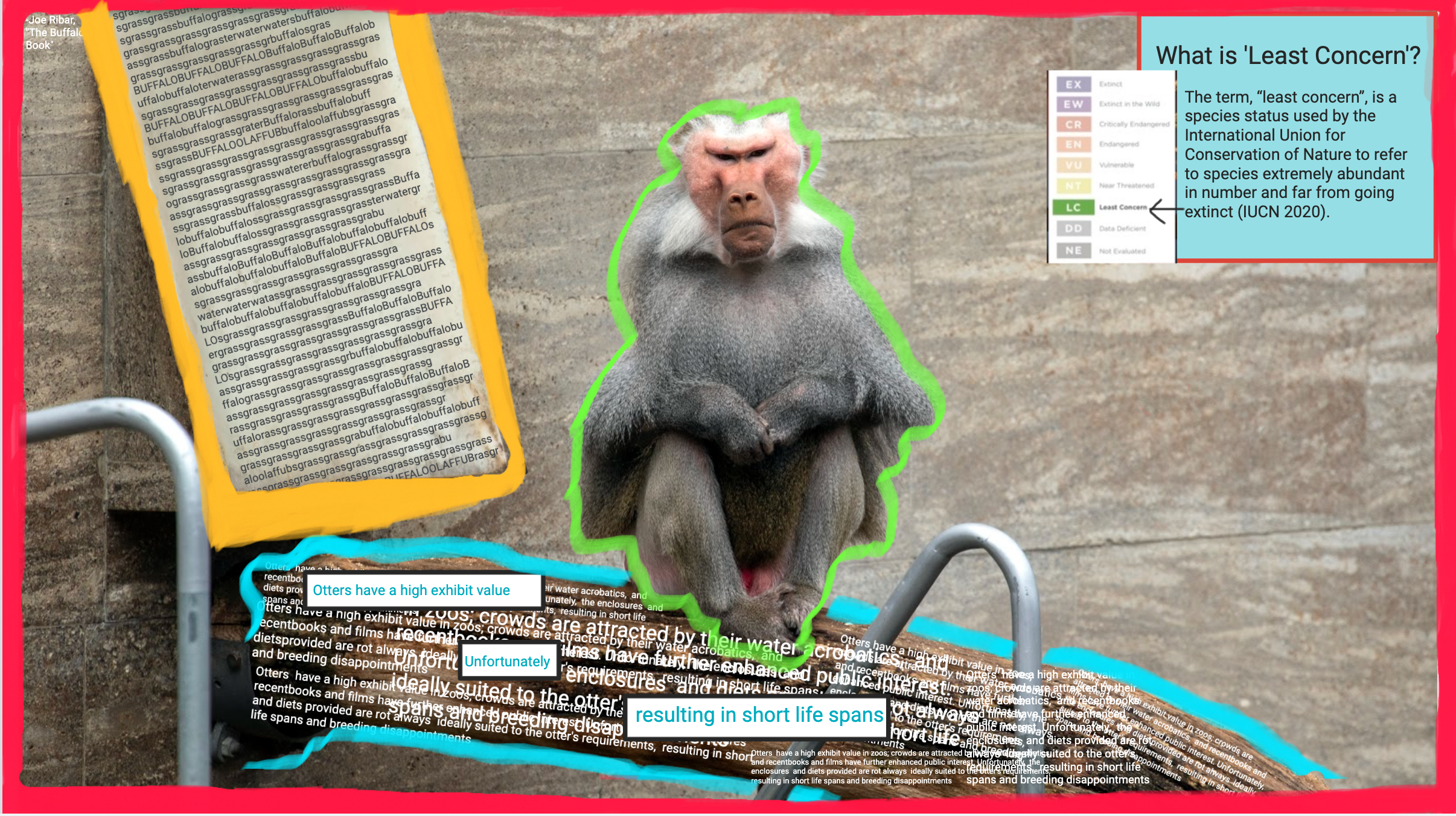
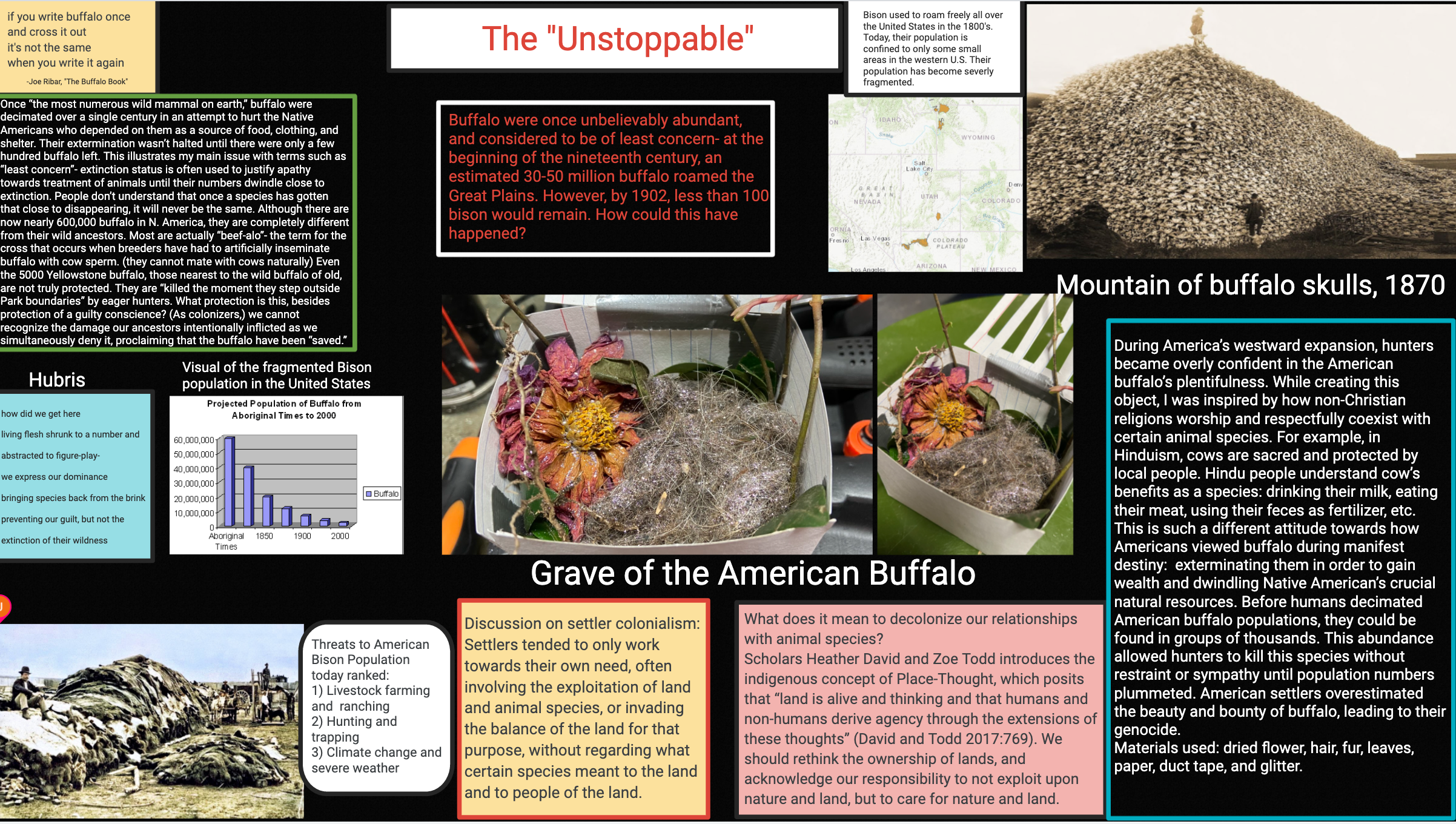
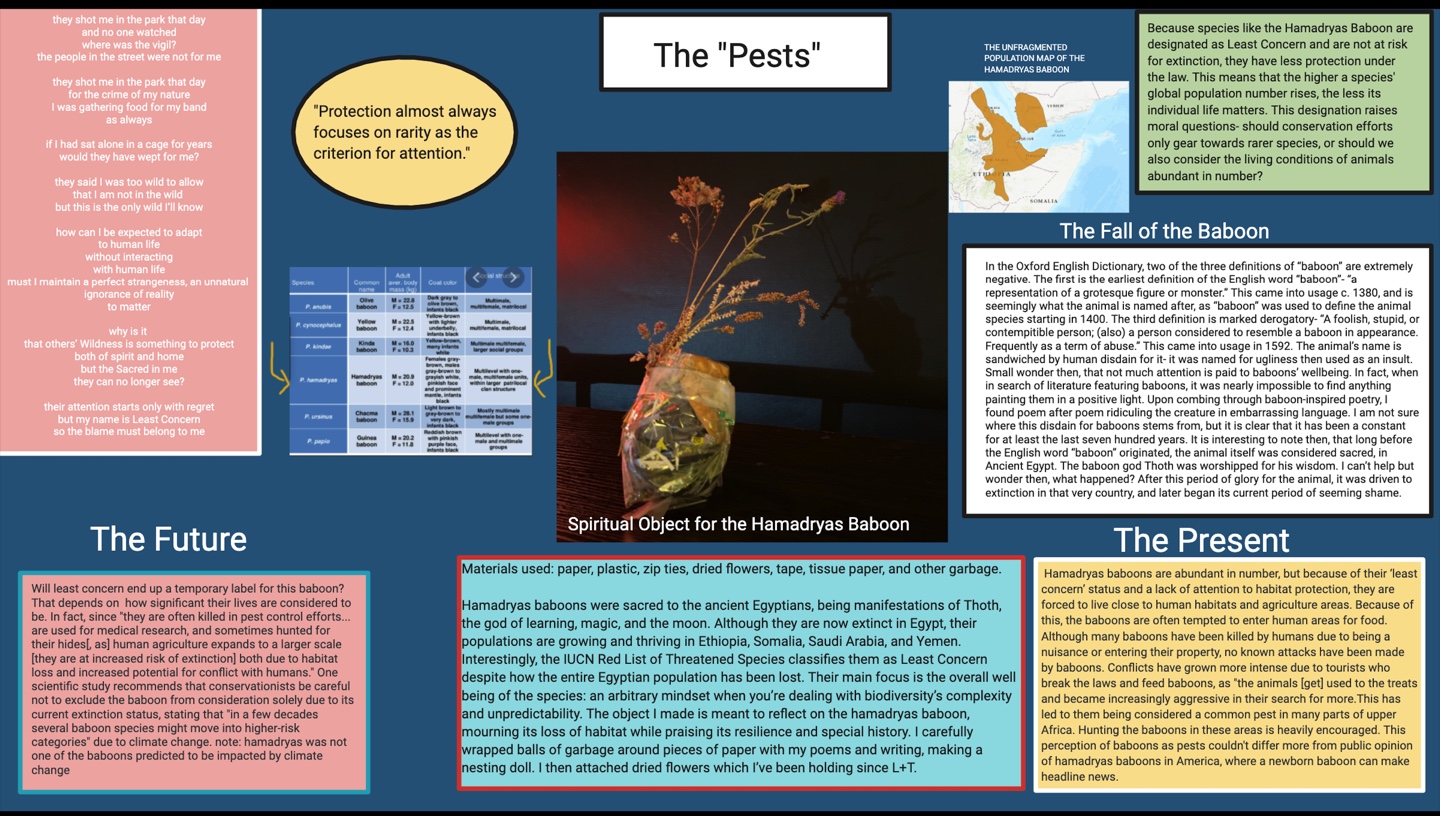
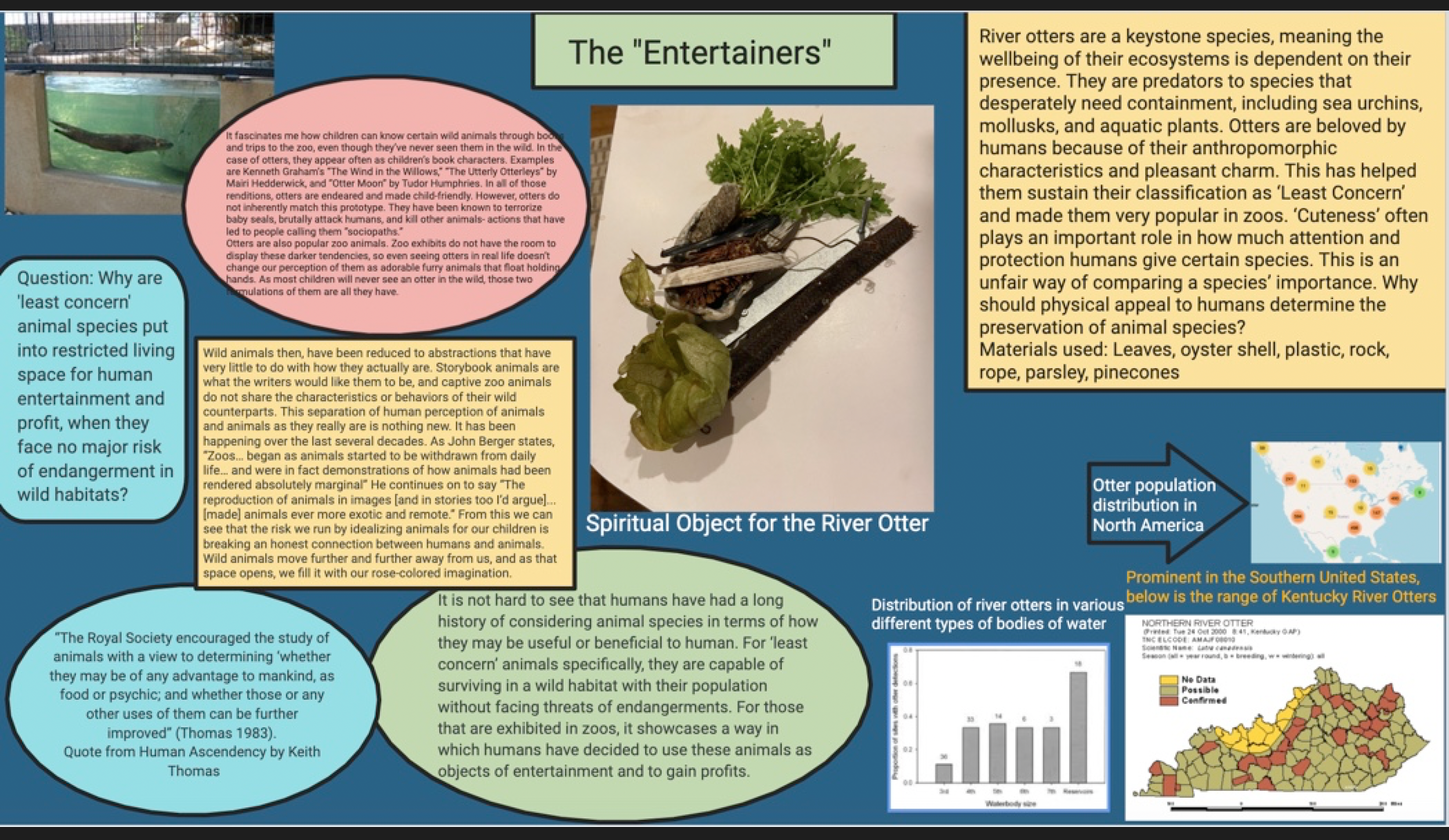
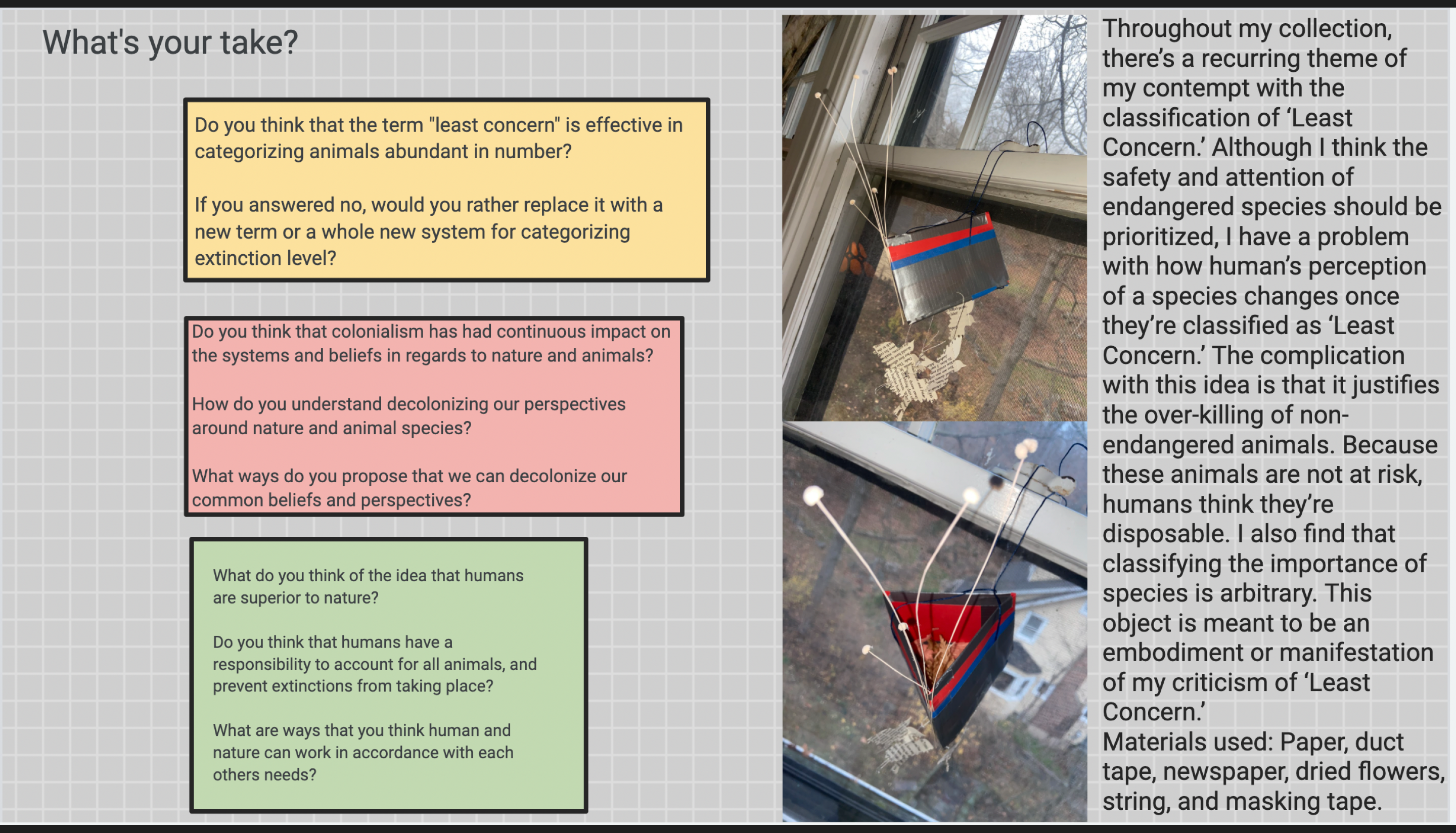
Our project focuses on the extinction scale classification of ‘least concern,’ and reflects upon the category’s effects on the perception of species under that classification. We explored the subject by studying its societal implications, creating art, and analyzing literature and scientific research. Mixed-media digital collages were utilized to present the collaboration between our four disciplines. Centered on each collage is a visual art piece dedicated to the animals, and constructed using a variety of unconventional media and materials.We gathered much of our information through the IUCN red list, as well as some data from scientific journals and other investigative articles and writings about the species. In order to discuss the growing separation between wild animals and human perception, we scanned poems and short stories that centered on specific species for tone. We found that people often create anthropomorphized versions of animals’ characters, and while those consensus are arbitrary, they’re also nearly unanimous. Finally, we encourage our audience to reflect upon the continuous impact that colonialism has on our way of understanding nature and animal species, and we point to the concept of decolonization, where the rethinking of our relationship to nature and animal species as human is crucial. We hope our presentation invites creative thinking into previously rigid scientific structures, and allows for self-questioning.
WORKS CITED
“Near Extinction of the Great Plains Bison 1820–1900.”
	Near Extinction of the Great Plains Bison 1820–1900 | Environment & Society Portal,
	www.environmentandsociety.org/tools/keywords/near-extinction-great-plains-bison-1820-1900

Gippoliti, Spartaco. “The IUCN Red List of Threatened Species.”
	IUCN Red List of Threatened Species, 4 Aug. 2016,
	www.iucnredlist.org/fr/species/16019/17953082.

Cormack Gates (IUCN SSC Bison RLA), et al. “The IUCN Red List of Threatened Species.”
	IUCN Red List of Threatened Species, 1 Sept. 2016,
	www.iucnredlist.org/fr/species/2815/123789863.

Manifest Destiny,
	www.cyberbee.com/manifest_destiny/population.html.

Conniff, Richard. “The Bison Returns to the Great American Plains.”
	Smithsonian.com, Smithsonian Institution, 1 Nov. 2018,
	www.smithsonianmag.com/science-nature/bison-returns-wilds-america-180970547/.

Maps of the Hamadryas Baboon’s Range
	https://www.researchgate.net/figure/Maps-of-the-hamadryas-
	baboon-range-including-terrain-roughness-a-altitude-b_fig1_270908331.

Angela Doroff (Kachemak Bay Research Reserve), and Alexandar Burdin
	(Kamchatka Branch of Pacific Institute of Geography). “The IUCN Red List of Threatened Species.”
	Sea Otter IUCN Red List of Threatened Species, 5 Jan. 2013,
	www.iucnredlist.org/fr/species/7750/21939518.

Robbins, Mike. “Where the Buffalo Roam – Jeanine Pfeiffer.”
	Flyway, 15 May 2018,
	flywayjournal.org/non-fiction/where-the-buffalo-roam-jeanine-pfeiffer/.

Ribar, Joe. The Book of the Buffalo. Figtree Press, 1971.
	(used his cover art to cover the object that goes to the buffalo collage when clicked)
	Also used a poem of his, but he is credited

“Sea Otter Necropsy Program.” CDFW Prod,
	wildlife.ca.gov/OSPR/Science/MWVCRC/Sea-Otter-Necropsy-Program.

Vanorio, Ame. “The River Otter - Slippery, Cute Fun!!” Fox Run Environmental Education Center,
	Fox Run Environmental Education Center, 11 Mar. 2016,
	www.foxrunenvironmentaleducationcenter.org/new-blog/2016/3/11/
	p778o90sc7tl73sderyly7jet0gdkv.

All That's Interesting. “25 Haunting Photos Of How The American Bison Was Hunted To Near Extinction.”
	All That's Interesting, All That's Interesting, 30 Jan. 2019,
	allthatsinteresting.com/american-bison-extinction-1800s.

https://eol.org/search?utf8=%E2%9C%93&q=Lontra+canadensis

All About Bison, https://allaboutbison.com/furriers-tanners/

Wikipedia Image of River Otter
	https://upload.wikimedia.org/wikipedia/commons/thumb/8/84/Alameda_
	Park_Zoo_North_American_River_Otter.jpg/256px-Alameda_Park_Zoo_
	North_American_River_Otter.jpg

Jimmy Nesbitt Journal. “Buffalo Hunted near Extinction in 1800s.”
	Rapid City Journal Media Group, 24 Sept. 2015 staff, Jimmy Nesbitt Journal.
	“Buffalo Hunted near Extinction in 1800s.” Rapid City Journal Media Group, 24 Sept. 2015,
	https://rapidcityjournal.com/news/local/buffalo-hunted-near-
	extinction-in-1800s/article_b8a6ae87-cebf-56a7-a7fb-6d061648a6c1.html

“Humans Declare War on Baboons.” Los Angeles Times, Los Angeles Times, 10 July 2005,
	www.latimes.com/archives/la-xpm-2005-jul-10-adfg-baboon10-story.html.

Written by Isabelle Catherine Winder, Lecturer in Zoology.
	“Baboons Are One of the Most Resilient Species at Risk from Climate Change.” World Economic Forum,
	www.weforum.org/agenda/2019/05/climate-change-is-putting-even-
	resilient-and-adaptable-animals-like-baboons-at-risk/.

Matthews, Dylan. “The Case against Otters: Necrophiliac, Serial-Killing Fur Monsters of the Sea.”
	Vox, Vox, 24 Apr. 2014

“Miriam Darlington's Top 10 Literary Otters.” The Guardian, Guardian News and Media, 13 Sept. 2012,
	www.theguardian.com/books/2012/sep/13/miriam-darlington-top-10-literary-otters.

Berger, John. Why Look at Animals? Penguin, 2009.

Duplaix, Nicole. (1972). Notes on maintaining river otters in captivity. International Zoo Yearbook.

Quote about rarity from baboon collage: Source: "City Wilds: Essays and Stories about Urban Nature.
	Greece, University of Georgia Press, 2002."

Thomas, Keith. Man and the Natural World: A History of the Modern Sensibility.
	New York: Pantheon Books, 1983.

IUCN 2020. The IUCN Red List of Threatened Species. Version 2020-2. https://www.iucnredlist.org.

Davis, Heather and Zoe Todd. ‘The Importance of a Date, or Decolonizing the Anthropocene.’ Acme Vol 16
	No. 4 (2017):761-780.